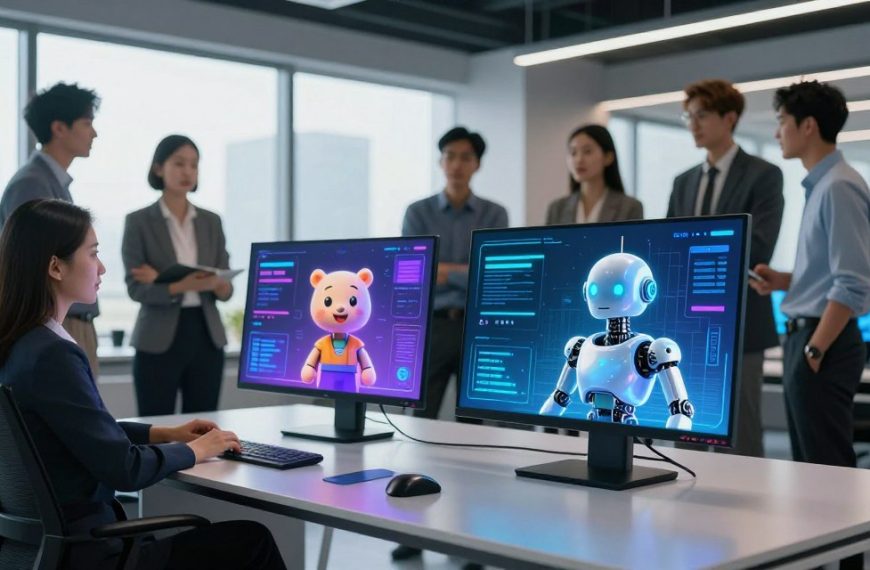


The world of artificial intelligence is changing fast. At the heart of this change are AI chatbots.
These digital helpers have grown a lot. They can now understand complex things, talk like humans, and do many tasks.
Chatbots are not just for answering simple questions anymore. They are becoming intelligent digital assistants. They will change how businesses work, improve customer service, and spark new ideas in all areas.
Understanding this change is key for leaders. It’s a big part of digital transformation. From healthcare to education, and even our daily lives, chatbots will have a big impact.
From Simple Scripts to Sophisticated Partners: The Chatbot Evolution
Chatbots have changed a lot, moving from simple scripts to smart AI helpers. This change is not just about better software. It’s a big shift in how machines talk to us. Now, they can understand and talk like us, thanks to conversational AI evolution.
The Journey from ELIZA to GPT-4 and Beyond
The chatbot history started in 1966 with ELIZA. Joseph Weizenbaum at MIT made it to mimic a psychotherapist. But, it only matched patterns and didn’t really understand the conversation.
For years, chatbots were limited. They could only do what they were told. But, with new tech, they started to get smarter.
Now, with GPT-4 and others, we see a huge leap. These systems learn from huge amounts of data. They can create new text that makes sense in the conversation. They don’t just follow scripts anymore.
Defining the Modern AI-Powered Chatbot
So, what makes a modern chatbot? It’s about systems that talk like us, thanks to AI. They use many techs:
- Machine Learning (ML): Helps them get better over time.
- Natural Language Processing (NLP): Lets them understand human language.
- Deep Learning: Uses complex networks to learn from text and speech.
This tech makes chatbots more than just simple answers. They can handle complex tasks now.
Key Differentiators: Context, Memory, and Reasoning
The big change is in three areas. These are what make today’s chatbots smart.
Context: Old chatbots didn’t remember the conversation. Now, they keep track of what’s said. This makes the chat flow smoothly and makes sense.
Memory: This is linked to context. Modern chatbots remember things from before. They can recall your preferences and past issues. This makes the chat more personal and builds a relationship.
Reasoning: This is the most advanced part. It’s about understanding and solving problems. It’s not just about giving answers. It’s about making sense of things and finding solutions.
Together, these three areas make chatbots more than tools. They become partners. This change is making a big impact in many areas of life. It’s a big step forward in conversational AI evolution.
The Engine Room: How Advanced AI Fuels Modern Chatbots
To grasp the future of chatbots, we must look at their engines. The move from simple menus to smart conversations is not magic. It’s thanks to big advances in artificial intelligence. Key technologies include large language models, NLP and NLU, and RAG technology.
Large Language Models (LLMs) as the Core Technology
At the heart of top chatbots are large language models. These are huge neural networks trained on vast texts and codes. They can spot patterns, create language, and even think.
Unlike old chatbots, modern LLMs can learn quickly. They can understand new ideas with little training. This is thanks to emergent abilities like zero-shot learning.
These models can now handle long conversations better. They generate language that’s clear, detailed, and fits the context. This is a big step up from simple replies.
Prominent Models: OpenAI’s GPT-4, Anthropic’s Claude, and Google’s Gemini
The chatbot world is led by a few main models. Each has its own strengths and ideas.
| Model | Developer | Key Characteristics |
|---|---|---|
| GPT-4 | OpenAI | Excels in creative tasks and broad knowledge; powers the widely known ChatGPT interface. |
| Claude | Anthropic | Emphasises safety, reduced harmful outputs, and has a large context window for lengthy documents. |
| Gemini | Designed from the ground up to be natively multimodal, integrating text, image, and audio understanding. |
These models are at the forefront. But, they’re general-purpose engines. Their true power comes from fine-tuning and other technologies.
Natural Language Processing (NLP) and Understanding (NLU)
Large language models create the words, but NLP and NLU help them understand. NLP is like a toolkit for breaking down language. It does tasks like splitting text into words and identifying parts of speech.
NLU goes deeper. It tries to understand the meaning, intent, and feelings behind words. This lets a chatbot know that “My order hasn’t turned up” and “The parcel is late” mean the same thing.
“The goal is not just to process language, but to comprehend intent. That shift from syntactic pattern matching to semantic understanding is what separates modern AI dialogue systems from the chatbots of the past.”
Retrieval-Augmented Generation (RAG) for Enhanced Accuracy
A big problem with LLMs is they can make up information. RAG technology solves this. A RAG-enhanced system checks external data before answering.
For example, a healthcare chatbot using RAG would look up the latest medical guidelines. This ensures its advice is accurate and up-to-date. This is key for fields like finance, law, and technical support.
The mix of a strong LLM, deep NLP and NLU, and RAG technology makes a powerful engine. It powers reliable and useful conversational AI across many industries.
Revolutionising Customer Service and Business Operations
Businesses are using conversational AI to change how they talk to customers and manage work. This change goes beyond just automating tasks. It makes companies more responsive, efficient, and smart.
Advanced chatbots are making services better, helping businesses grow, and making work more productive.
Providing 24/7 Support and Instant Query Resolution
Customers now expect help anytime. Intelligent chatbots meet this need by answering common questions and solving simple problems. This makes customers happier and more loyal to the brand.
These AI tools help human teams, not replace them. A study from Harvard Business School found AI makes human agents 20 percent faster. It helps new staff members do better too.
AI also helps agents be more empathetic and thorough. For example, it can suggest alternative plans when a customer wants to cancel. This makes customers feel understood.
AI can help companies keep customers who pay for services or subscriptions.
This shows how AI customer service can handle lots of tasks quickly. It lets humans focus on giving better support.
Driving Personalised Marketing and Sales Conversions
Chatbots are not just for answering questions. They can start conversations with product suggestions based on what customers have bought before. This makes chatbots a powerful tool for sales.
These AI assistants are great at finding out if someone is a good lead. They can talk to website visitors, answer questions, and check if they can afford what they’re interested in. Then, they pass on the best leads to sales teams.
The key is personalised marketing AI. It lets companies talk to customers one-on-one, making offers that really appeal. Chatbots can guide customers through products, suggest extras, and even offer discounts. They also collect data for future campaigns.
Streamlining Internal Processes and Human Resources
AI is changing how companies work on the inside too. Chatbots are making work easier by taking over routine tasks. This makes departments more efficient.
In HR, AI helps with onboarding. It sends out documents, answers questions, and sets up training. For IT, chatbots solve simple problems like password issues. This lets experts work on harder problems.
The results are clear: lower costs, fewer mistakes, and happier staff. People can focus on creative work while AI handles the routine. This makes companies more agile and ready for new challenges.
| Business Function | Chatbot Application | Key Benefit | Typical Outcome |
|---|---|---|---|
| Customer Service | 24/7 query resolution, agent assistance | Higher satisfaction, increased retention | 20% faster response times, more empathetic interactions |
| Marketing & Sales | Lead qualification, personalised recommendations | Higher conversion rates, increased average order value | Seamless handoff to sales teams, data-driven targeting |
| Internal Operations (HR/IT) | Onboarding support, IT helpdesk triage | Reduced administrative burden, lower costs | Faster process completion, improved employee experience |
These changes add up to a big transformation. Companies using these tools are building stronger relationships with customers, selling smarter, and working more efficiently. The future of business is all about talking, personalising, and automating.
Transforming Healthcare Delivery and Patient Support
Conversational AI is changing healthcare in big ways. Healthcare chatbots are now key parts of patient care. They make support easier, more proactive, and based on data.
Triage Services and Preliminary Symptom Checking
They help with first checks. Medical triage AI looks at symptoms and gives advice. It tells you if you need to see a doctor or go to the hospital.
A tool for cancer risk is a great example. It uses big data and medical knowledge to give personal risk scores. It helps manage big data and gives tailored advice, just like other specialised AI systems.

Mental Health First Response and Therapeutic Chatbots
Mental health services are often too busy. AI mental health support offers quick, private chats. It helps with anxiety, mood tracking, and CBT.
These bots are not a full replacement for doctors. They’re there for quick help or daily support. They offer tips and exercises, helping people feel more comfortable seeking help.
Supporting Medication Adherence and Chronic Condition Management
Managing long-term conditions needs daily effort. Healthcare chatbots send reminders and educational content. They help patients stay on track.
Patients can share symptoms and data with the bot. The AI checks for trends and alerts doctors. This helps patients take charge of their health and gives doctors more information.
| Application Area | Primary Function | Key Benefit |
|---|---|---|
| Triage & Symptom Checking | Preliminary assessment and care guidance | Reduces unnecessary clinical visits and optimises resource allocation |
| Mental Health Support | Immediate response, therapeutic conversation, mood tracking | Provides 24/7 accessibility and reduces stigma around seeking help |
| Chronic Condition Management | Medication reminders, education, symptom logging | Improves patient adherence and outcomes, enables proactive care |
AI in healthcare is making care more personal and responsive. From first checks to ongoing care, these tools are essential. They improve patient experience and help healthcare teams provide better care.
Redefining Education and Personalised Learning
Imagine a tutor always ready to help, guiding you through tough subjects at your pace. This is what conversational AI in schools offers. It’s moving us away from one-size-fits-all learning to personalised learning. These chatbots are more than helpers; they’re key players in teaching, providing support and insights.
The Rise of AI Tutors and Intelligent Homework Assistants
Old educational programs are gone. Now, AI tutors can have real conversations. They explain maths, give feedback on essays, and answer questions anytime. This support is a game-changer for AI in education.
Students don’t have to wait for help anymore. An AI homework assistant can explain physics or test your vocabulary anytime. This constant help helps students catch up and feel more confident. It lets them take charge of their learning.
Creating Adaptive Learning Pathways for Every Student
AI’s real strength is in customising learning. It looks at how students interact and do on quizzes to create a learning plan just for them. It adjusts the difficulty of tasks and introduces new ideas when you’re ready.
This makes learning paths that really work for each student. Struggling students get extra practice, while advanced ones get more challenging material. This approach makes sure no one is left behind and everyone is challenged, helping the whole class learn more efficiently.
Administrative Automation for Educational Institutions
AI is changing schools too. Chatbots are taking over routine questions, freeing up staff to focus on important work:
- Answering common questions about school life.
- Helping with timetables and room bookings.
- Providing quick access to study materials and campus services.
This makes schools run smoother and improves the experience for everyone. It lets teachers and staff do what they do best.
But, this change doesn’t forget the importance of human connection in learning. As learning scientist Mary Helen Immordino-Yang says, emotions and social experiences shape our learning. It’s the relationships that make learning safe and exciting.
Cognitive processes like reasoning, attention, and memory are profoundly shaped by emotional and social experiences.
The best use of AI in education is to enhance, not replace, human teaching. AI can personalise learning and handle routine tasks. But, it’s the teachers who inspire and support, making learning truly meaningful.
The Future of Work: AI as a Collaborative Partner
AI chatbots are not here to replace us. Instead, they’re designed to make our work better. They take on the boring tasks and complex data analysis. This lets us focus on the creative and strategic parts of our jobs.
This change is a big step forward. It means businesses can save money and work more efficiently. But, it also means we need to learn how to work with AI. The goal is to make our work and AI’s work better together.
Augmenting Human Creativity and Analytical Productivity
AI chatbots are great at helping us think creatively and analyze data. They can help come up with ideas and suggest new ways to look at things. This helps us work faster and think outside the box.
They’re also good at sorting through lots of data. They can spot trends and make quick reports. This helps us make better decisions based on solid information.
The Emergence of New Roles and the Shift in Required Skills
As AI takes on more tasks, new jobs are being created. We need people who can train AI, make sure it works well, and integrate it into our work. These roles are key to making AI work for us.
So, what skills do we need now? We need to be good at using technology, but also at thinking critically and solving problems. Being able to work with AI is becoming a must-have skill for everyone.
Chatbots as Co-pilots in Creative and Technical Tasks
AI is becoming our co-pilot in many areas. In coding, it helps write code and find bugs. In creative fields, it helps with ideas and designs.
In writing, law, and finance, AI does the initial work. Then, we add the final touches. This way, AI and humans work together to make things better.
This partnership is changing how we work. It’s not about AI replacing us, but about working together. The best companies will be those that know how to use AI well.
How is Chatbot Going to Change the World of Finance and Commerce?
The finance and commerce world is set for a big change. This change comes from using advanced conversational AI. It’s not just about answering simple questions anymore. Now, chatbots help with things like managing wealth, keeping things safe, and shopping.
This change means better efficiency, personalisation, and security. It makes services available to more people. The effect of AI in finance and commerce will be seen in every deal and financial choice.
Delivering Personalised Financial Advice and Enhancing Fraud Detection
Getting detailed financial advice is no longer expensive. Modern chatbots use big data to give advice on budgeting, saving, and investing. They do this based on your spending habits and goals.
These systems also boost security. They use fraud detection AI to watch transactions closely. They spot odd patterns, like unusual logins or big purchases, fast. This helps protect your money.
Personalised service and better security create trust. You get a partner in managing your money, not just a tool for checking balances.
Automating Routine Banking and Insurance Processes
Many customer interactions in finance are routine tasks. Chatbots are now handling these tasks well. This lets human staff focus on more complex issues.
- They give real-time account balances and recent transactions.
- They explain fees or charges on statements.
- They help with disputes over unauthorised transactions.
- They guide through the first steps of an insurance claim.
This automation means quick, 24/7 help for customers. It also cuts costs for banks and insurance companies. Tasks like updating details or ordering a new card are now quick and easy.
The Evolution of Intelligent Shopping Assistants
Chatbots in commerce have grown from simple FAQ tools to smart shoppers. Modern intelligent shopping assistants have deep conversations. They understand your needs, style, and budget.
These AI helpers guide you from start to finish. They compare items, alert you to sales, and help with sizing and delivery. This makes shopping more personal and increases sales for retailers.
The future is even more exciting. Imagine a smart shopping assistant that knows you’re planning a holiday. It suggests travel adaptors, sunscreen, and a guidebook. This is the next step for AI in commerce, making shopping seamless and intuitive.
Smart Homes and Personal Assistants: The Integrated Life
Our homes are getting smarter, thanks to AI and the Internet of Things (IoT). This change moves smart home AI from remote apps to natural talk. Now, conversational personal assistants are at the heart of our homes, making life easier.
Centralising Domestic Control Through Conversational AI
Today’s smart homes can be complicated. Different brands and apps make controlling them hard. But, advanced chatbots offer a simple solution. They act as a voice or text command centre for everything.
With them, you can easily manage:
- Climate and lighting: “Set the living room to 22 degrees and dim the lights.”
- Security systems: “Show me the front door camera and lock the garage.”
- Entertainment and appliances: “Play my podcast in the kitchen and start the coffee machine.”
The assistant understands what you mean, controls the right devices, and confirms actions. It turns your gadgets into a well-coordinated, smart home.

Proactive Management and Predictive Personal Assistance
The big change is moving from just following commands to proactive AI management. Modern systems learn your habits, likes, and context. They use data like weather and your schedule to guess what you need before you ask.
Your assistant might suggest taking an umbrella for rain or warm up your home before you get back. It can even pause the vacuum when you’re on a call. This smart thinking is what makes next-gen personal chatbot assistants special.
This makes your home more than just a tool. It becomes an active partner in making your life better. Your home now works to improve your comfort, efficiency, and happiness.
Addressing Ethical and Societal Challenges Head-On
Future AI chatbots need more than just tech; they need ethics too. Their power comes from personalising, being always there, and convincing us. But, these powers also bring big risks. We must tackle these risks together.
We need strong rules for using this tech. This way, we can make sure it’s used for good.
Combating Bias, Ensuring Fairness, and the Transparency Deficit
The problem of AI ethics and bias starts with the data. If the data is biased, so will the chatbot. This can lead to unfair decisions in many areas.
To fix this, we need a few steps. First, use data from all kinds of people. Then, check the chatbot’s code often. And last, make sure we can understand how it works.
- Diverse Data Curation: Get data from different people and views.
- Bias Detection Tools: Use software to spot and fix biased chatbot answers.
- Human-in-the-Loop Reviews: Have a human check important decisions.
Data Privacy and Security in an Always-On Conversational World
Chatbots deal with very personal info. This makes data privacy AI very important. People are worried about how their data is used and shared.
To keep data safe, we need strong encryption and clear privacy rules. This is critical in areas like mental health, where apps can be risky.
We must treat data as private and make sure chatbots help, not harm us.
Navigating Job Displacement Concerns and the Digital Divide
AI chatbots make us worry about losing jobs. But, they’re meant to help, not replace us. They’ll make some tasks easier, freeing us up for more important work.
But, we also need to avoid making things worse. If AI is only for the rich, it could make things unfair. We need to make sure everyone can use these tools.
We want chatbots to help everyone, not just the few who can afford them. We need to invest in digital skills for all.
Dealing with these issues is key to making AI better for everyone. By focusing on fairness, safety, and access, we can make sure AI helps us all.
The Blurring Line: Chatbots, Avatars, and Embodied AI
Imagine a chatbot with a face, voice, and emotions. This is the future of embodied AI. The difference between simple chatbots and digital friends is disappearing. Millions now find comfort and support in these advanced beings.
Platforms like Replika.ai and Xiaoice have hundreds of millions of users. In 2024, users of Character.ai spent 93 minutes daily with chatbots. This shows a big change from just using them for tasks to forming real connections.
From Text to Voice and the Rise of Realistic Digital Humans
Chatbots started with text. Now, they have voices and faces. Early chatbots were just text commands. Today, they use voices that feel real.
This change brings us AI avatars that look and act like humans. They can look at you and show emotions. These digital humans AI are a big step towards talking like we do.
This progress makes chatbots feel more like friends. They offer a connection that text alone can’t give.
Applications in Entertainment, Social Connection, and Digital Therapy
Embodied conversational agents are being used in many ways. They are changing our daily lives.
In games and stories, AI avatars are becoming more than just characters. They can talk and change the story. This makes games more personal and fun.
For those feeling lonely, these technologies offer a way to connect. Apps with digital friends can talk all day. They meet our need for conversation.
Digital therapy is also getting better. Digital humans AI can help with mental health. They can talk to you and help with therapy.
The table below shows how chatbots have changed:
| Aspect | Traditional Chatbot | Embodied AI Agent |
|---|---|---|
| Primary Interface | Text-only | Multimodal (Voice, Visual) |
| User Engagement | Transactional, task-focused | Relational, emotion-focused |
| Typical Application | Customer service FAQ | Companionship, coaching, therapy |
| Technological Core | Rule-based or simple NLP | LLMs, emotional AI, computer vision |
This change raises big questions. Can we tell the difference between real and fake? There are huge privacy issues with these advanced beings. The industry must be careful and open about this.
The rise of embodied conversational agents is a big moment. AI is becoming a part of our lives. It’s moving from a tool to a friend.
The Road Ahead: Towards Multimodal and Autonomous AI Agents
Conversational AI is moving beyond simple chat windows. It’s becoming systems that see and act on the world, like in science fiction. Today’s chatbots are just the start. The next step is to have systems that can see, hear, and act on their own, changing how we use technology.
Beyond Text: Integrating Vision, Sound, and Direct Action
The future is multimodal AI. This new AI can understand and create text, images, and sounds. Imagine an assistant that can look at a photo, talk about it, and then show you how to fix it.
These systems will use cameras to see and understand what you show them. They can even listen to your voice and know how you feel. This makes talking to them feel more natural and friendly.
But the biggest change is that these systems will take direct action. They won’t just suggest things; they’ll do them. They can book flights and hotels for you, making things easier and more efficient.
The Development of AI Agents That Execute Complex Tasks Autonomously
This leads to autonomous AI agents. These systems can do things on their own, like planning a trip. They can break down big tasks into smaller ones and do each step.
For example, they might find clients, book meetings, and plan your trip. They work with different services and learn from feedback, getting better over time.
These agents need fast and local processing. Edge computing is key. It makes things happen quicker and keeps your data safer by not sending it far away.
The Long-Term Vision: Steps on the Path to General Artificial Intelligence
These advancements are steps towards general artificial intelligence (AGI). AGI is a machine that thinks and acts like a human. While AGI is far off, these advancements are important steps.
Each new skill, like understanding images or solving problems, adds to a bigger intelligence. As one researcher said,
“We are not building a monolithic artificial mind, but a toolkit of cognitive skills that can be combined and scaled.”
AI chatbots are getting closer to robots and the Internet of Things. This makes them more than just tools. They are building blocks for flexible, multi-skilled AI systems. The goal is to have assistants that can handle many tasks and challenges.
The future is about working together more closely with AI. We need to solve problems like making AI reliable and ethical. This will take us from helpful chatbots to true partners in our daily lives.
Conclusion
The move from simple programs to advanced AI like GPT-4 is a big leap. Today’s chatbots are smart partners, changing how we use technology and talk to each other.
This change is a big deal. It’s making businesses, healthcare, education, and our homes more efficient and personal.
The future of AI chatbots looks bright. They will get better at understanding us, becoming more helpful and proactive. They will go from being tools to being true partners.
But, there are big challenges ahead. We need to make sure these systems are fair, keep our data safe, and handle any economic changes. We must be careful and thoughtful.
The path is clear. By using AI wisely, we can make a better future. The impact of AI chatbots is shaping our world today.
FAQ
What is the key difference between early chatbots like ELIZA and modern AI chatbots?
Early chatbots like ELIZA followed simple rules and didn’t really understand language. Today’s AI chatbots, like OpenAI’s GPT-4, can understand and respond to natural language. They keep the conversation going and give answers that sound like they came from a human.
How do technologies like NLP and RAG make chatbots more accurate and useful?
NLP and NLU help chatbots understand what we say. Retrieval-Augmented Generation (RAG) uses real data to make sure answers are correct. This makes chatbots more reliable and less likely to make things up.
Can AI chatbots really improve customer service, or do they just frustrate customers?
AI chatbots can really help with customer service. A Harvard Business School study found they can work alongside humans to offer quick, caring support. They handle simple questions fast, so humans can focus on harder issues. They also help with marketing and sales, making things more efficient and satisfying for customers.
How are chatbots being used in healthcare, and is it safe?
Chatbots are changing healthcare by helping with symptoms, mental health, and managing chronic conditions. For example, they can check cancer risk based on what you tell them. It’s safe if they’re trained well, clearly say they’re not a doctor, and follow strict privacy rules like HIPAA.
Will AI tutors in education replace human teachers?
A> No, AI tutors are meant to help, not replace teachers. They offer help anytime and can tailor learning to each student. This lets teachers focus on important skills like thinking and creativity. They also help with tasks like answering questions about school.
What is an AI “co-pilot” in the workplace?
An AI co-pilot is a chatbot that works with you. It helps with ideas, writing, and sorting through data. This lets humans focus on strategy and creativity. It’s about working together, with the AI doing the routine tasks and humans guiding the way.
How is chatbot technology changing personal finance?
Chatbots are making finance more accessible by giving advice on spending and saving. They also spot fraud quickly. They do things like check balances and file claims, saving time and effort for customers.
What are the biggest ethical concerns surrounding widespread chatbot adoption?
Big worries include chatbots showing bias and not being clear about how they make decisions. There’s also a risk of privacy breaches. There are concerns about jobs, the digital divide, and the ethics of AI companions. We need to be careful and responsible with chatbot development.
What are “digital humans” or embodied AI?
Digital humans are chatbots with avatars and voices that seem real. They’re used in games, as friends, and in therapy. They’re exciting but raise questions about feeling too close to them and what’s real and what’s not.
What is the next major evolution for chatbot technology?
The next step is multimodal and autonomous AI. Multimodal AI can handle text, images, and sound at the same time. Autonomous AI can plan and do things on its own, like booking a trip. This is a big step towards AI that can do more on its own.


 By
By