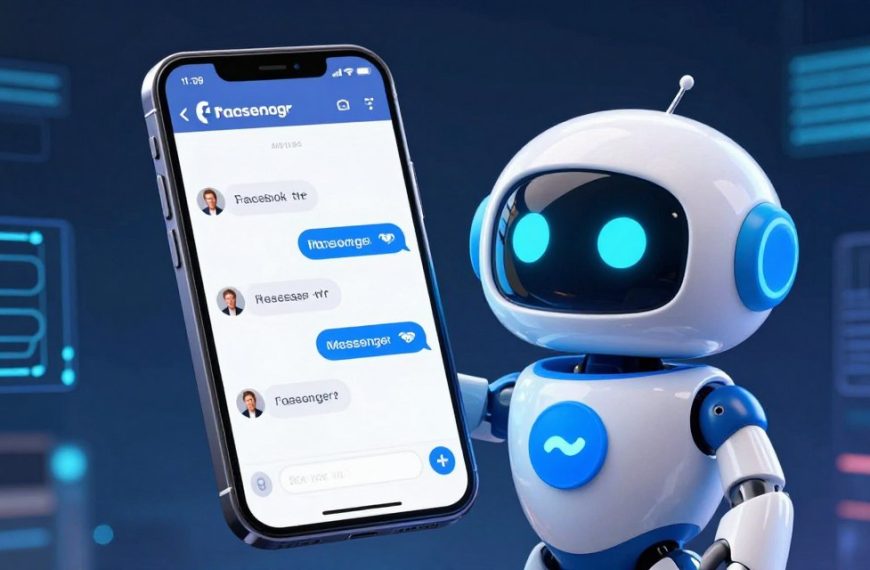


Generative AI, like ChatGPT, has changed how we write. It helps with emails and essays. But, it raises questions about originality and ownership.
Old plagiarism checkers looked for copied human texts. Now, they must find AI-created content. This is a battle between new technology and old ways of checking.
The big question is: can we tell if AI-generated text is not from a human? It’s not just a tech problem. It’s about academic integrity and ethics in the digital world.
This article dives into the world of AI plagiarism detection. We’ll look beyond simple answers. We’ll explore how detection tools work, their limits, and what it means for writers and teachers.
A second useful reference here is a guide to asking ai, which adds more context around setup, use cases, or limitations.
That same practical question also connects well to how chatbots are going to in a related chatbot use case.
The Rising Confluence of AI Writing and Integrity Checks
AI-generated text is everywhere now, leading to a new battle. Forensic software is fighting to uncover its true origins. This battle is critical in schools and publishing, where trust is everything.
The Proliferation of Generative AI Chatbots
Tools like ChatGPT made AI writing easy for everyone. They are simple to use, very good at writing, and often free. People use them for writing, brainstorming, and editing every day.
A student named “Alex” found ChatGPT great for his essays. He even sold them online. This shows how tempting these tools can be, leading to ChatGPT academic dishonesty.
But, these tools warn against cheating. OpenAI tells users not to use ChatGPT for dishonesty. Yet, many ignore this warning to get ahead.
The Parallel Development of AI Detection Software
As AI tools grew, so did the need for detecting them. Schools and publishers were worried about cheating. Companies like Turnitin updated their tools, and new startups like GPTZero and Originality.ai were born.
This was a quick response to a big problem. The goal was to find ways to spot AI-written texts. These tools look for unique styles and patterns not found in human writing.
This has led to a never-ending battle. Every time AI gets better, detection tools get better too. This keeps the fight going, making it hard to predict what will happen next.
| Aspect | AI Chatbot Proliferation | AI Detection Development |
|---|---|---|
| Primary Driver | Democratisation of powerful, user-friendly technology | Institutional demand for academic and content integrity |
| Key Example | ChatGPT’s viral adoption by students and professionals | Turnitin’s integration of AI detection into its flagship service |
| Typical User | Students, content creators, researchers seeking efficiency | Educators, publishers, editors verifying originality |
| Response Time | Rapid, organic integration into workflows | Reactive, but development pace is accelerating |
| Current Challenge | Managing ethical use and preventing ChatGPT academic dishonesty | Achieving high accuracy while minimising false accusations |
This ongoing battle creates a unique world. For every new AI tool, there’s a tool to detect it. Understanding this is key to solving the big questions it raises.
Redefining Plagiarism for Algorithmic Authorship
AI now makes text that seems human-made. This means we need to rethink what plagiarism is. The old rules, made for humans, don’t fit with AI’s new way of creating.
Traditional Plagiarism: Copying Human Expression
Plagiarism used to be simple. It’s when someone copies or closely imitates another’s work without saying so. This is a big no-no because it takes away the original creator’s credit.
Tools like Turnitin help find this by checking work against a huge database of human texts.
The AI Quandary: Originality Without a Human Author
AI creates text that’s new, but not in the way we think. It’s made from patterns in its training data, not copied from one source. There’s no single human author to steal from.
This makes us wonder: is AI-generated text plagiarism if it’s technically new? The idea of AI writing originality is different from human creativity. It’s more like remixing than stealing.
This is where things get tricky. The text is new, but it comes from a machine trained on lots of documents.
Transparency as the New Ethical Imperative
In this unclear area, being open is key. The main issue is not copying, but not telling who helped you. It’s important to say who helped with the writing.
AI systems, like OpenAI’s ChatGPT, say it’s wrong to pass off their text as your own. They even give tips on how to properly credit them.
Copying ChatGPT’s language and saying it’s your own could be seen as plagiarism in some cases.
So, the new standard for AI writing originality is not just being unique. It’s also about being honest about who helped you. Citing the AI tool, like you would a database or paper, is the best way to stay honest.
This changes how we see authorship. It’s now a team effort, where humans guide and refine the work. Being open about where the ideas come from is key.
Mechanics of Chatbot Text Generation
At the heart of every modern chatbot is a complex engine. It’s built on Large Language Models. To understand if their output can be caught for plagiarism, we need to know how it works. It’s a process of assembly, not authorship, based on statistics, not thought.
Foundations in Large Language Models (LLMs)
Chatbots like ChatGPT use Large Language Models. These models are complex neural networks, similar to the human brain. They’re trained to understand and generate human-like text by spotting language patterns.
The “large” in LLM means the model has a huge number of parameters and learns from a vast amount of data. This technology lets chatbots respond to many prompts with relevant text.
The Role of Vast and Varied Training Datasets
The ability of an LLM depends on the data it’s trained on. It learns from a huge part of the internet’s text. This includes books, articles, and websites, creating a comprehensive linguistic database.
This data is not checked for accuracy or ethics. The model aims to learn word and phrase relationships. It learns common syntax and structure, which is key for research into AI detection.
But, the model also learns biases and copyrighted material from its data. It does this without understanding the content.
Statistical Prediction, Not Text Retrieval
A chatbot doesn’t copy and paste answers. It generates each word one at a time, based on probability.
It looks at the prompt and its own response, then picks the next word based on likelihood. Eric Wang from Turnitin says this creates a detectable “statistical artifact” in the text.
The output is an original combination, but it’s algorithmic. It lacks the unique “human touch” found in genuine writing. This is what AI detection tools aim to spot.
How AI Detection Tools Analyse and Flag Content
AI detection tools use advanced methods to check content. They don’t look for copied text in a database. Instead, they examine the text’s unique features, like those found in AI writing.

Core Detection Methodologies: Perplexity and Burstiness
Two main metrics are at the core of these detectors: perplexity and burstiness. Perplexity measures how surprising a text is to AI. Human writing is often unpredictable, with creative touches and small mistakes.
AI text, trained on big datasets, tends to be more predictable. This makes it less surprising to AI models. Burstiness looks at sentence length and structure. Humans mix short and long sentences, while AI might stick to one style.
Leading Tools: Turnitin, GPTZero, and Originality.ai
Several tools lead in AI detection, each with its own method. Turnitin’s AI detection checks for patterns from GPT-3 and GPT-4. It’s confident in catching today’s AI writers.
GPTZero focuses on perplexity and burstiness. Originality.ai targets content creators, checking for AI and plagiarism. These tools are key in checking content integrity.
Inherent Limitations and the Risk of False Positives
These tools are not perfect. They can wrongly flag content as AI-written. A Stanford University study showed a big problem: they often mistake non-native English essays for AI.
Non-native writing can seem too predictable and uniform, like AI. This can lead to unfair accusations. It’s important to remember that a positive result doesn’t prove AI use.
Other issues can also cause false positives. Topics with strict formats, technical writing, or even polished human drafts can be misjudged. This means we need to carefully review any detection results.
Can a Chatbot Be Caught for Plagiarism? The Central Analysis
At the heart of the debate lies a nuanced reality: detection by software is increasingly likely, but a plagiarism charge is not automatic. A chatbot itself cannot be ‘caught’ or held responsible, but the content it generates can be flagged by AI detection tools. This leads to serious accusations against the human user.
This process involves two distinct stages. First is the technical, algorithmic analysis. Second is the human judgement and institutional response that may follow. Understanding this separation is key for anyone using generative AI.
Detection is Probable, Accusations are Possible
Modern AI detection tools are designed to identify statistical patterns indicative of machine generation. When a submission is a raw, unaltered output from a chatbot, the probability of it being flagged is high. This is the technical ‘detection’ phase.
But an accusation of plagiarism is a human-driven action. It depends on an institution’s policy and the user’s transparency. A student like Alex, from the provided data, showed that careful editing and synthesis of AI-assisted work could pass plagiarism checkers. His less careful peers, submitting verbatim AI text, faced a much higher risk of both detection and formal accusation.
The key takeaway is that detection tools provide a signal, not a verdict. The move from a technical flag to a formal sanction involves review, context, and policy.
Scenarios Most Likely to Trigger Plagiarism Alerts
Not all AI-generated content carries equal risk. Certain usage scenarios dramatically increase the chance of triggering an alert from both plagiarism and AI detection software. These scenarios share common technical footprints that algorithms are trained to spot.
The primary risk factors include the submission of lengthy, unedited blocks of text. These outputs typically exhibit low ‘perplexity’ and high ‘burstiness’—statistical signatures of machine generation. Prompts that are overly simple or generic also produce more predictable, and detectable, text.
| Usage Scenario | Technical Characteristics | Likelihood of Alert |
|---|---|---|
| Unedited, verbatim chatbot output | Extremely low perplexity, high stylistic uniformity | Very High |
| Lightly paraphrased AI content | Moderate perplexity, some burstiness | High |
| Heavily edited and synthesised AI-assisted work | High perplexity, human-like burstiness | Low |
| Human-written content with predictable phrasing | Unnaturally low burstiness | Risk of False Positive |
As the table illustrates, the more human effort involved in altering and owning the final text, the lower the technical risk. The final row highlights a critical caveat: human writing can sometimes mimic AI patterns, leading to errors.
Distinguishing Technical Detection from Ethical Breach
This is the most critical distinction in the entire debate. A piece of content can be detected as AI-generated without that constituting an ethical breach. The determining factor is often transparency.
If an institution permits AI assistance with proper citation, a positive detection result is merely a confirmation of disclosed use. No plagiarism exists. The ethical breach occurs when AI-generated text is presented as one’s own original human work, violating academic or professional integrity.
The major complication, though, is the proven unreliability of the detectors themselves. As noted in Source 3, these tools are often “unreliable and easily gamed.” This unreliability manifests most dangerously in false positives—where wholly human-written content is incorrectly flagged as AI-generated.
A false positives AI detection event blurs the line entirely, potentially leading to wrongful accusations. This risk makes reliance on these tools as sole arbiters of integrity profoundly problematic. It highlights that while technical detection is probable, the leap to a plagiarism accusation must be handled with extreme caution and human oversight.
Ultimately, being ‘caught’ depends less on the chatbot’s abilities and more on the user’s practices and the robustness of the institutional framework evaluating the work.
Key Factors That Affect AI Text Detectability
Detecting chatbot output is complex, influenced by user input, text features, and the growth of analytical tools. AI detection tools are powerful but not perfect. Several factors decide if AI writing passes checks or raises red flags.
The Impact of Prompt Specificity and Complexity
How you ask for content is key. A simple prompt like “write an essay on climate change” often has predictable patterns. This makes it easier for detectors to spot.
But, complex prompt engineering changes the game. Asking an AI to “rewrite this draft with more sophisticated language” can trick basic detectors. This method, known as iterative prompting, adds human-like complexity.
Using multi-step prompts that ask for specific tones or formats forces AI to be more creative. This results in text that’s harder to detect. Changing your prompts can make AI writing less detectable.
Influence of Output Length and Stylistic Uniformity
Longer AI texts are more likely to be detected. Why? It’s hard for humans to keep a uniform style over thousands of words. AI does it easily, making it a red flag for detectors.
Shorter texts or those mixed with human writing are harder to detect. Human writing has natural variation in style, which AI lacks. Uniform AI texts challenge academic integrity AI tools.
The Evolving Capabilities of Detection Algorithms
This is not a static problem but a dynamic race. What evades detectors today might not tomorrow. Companies like Turnitin and Originality.ai keep updating their models to catch new tricks.
This makes it risky to rely on just one trick. The landscape is always changing. Staying up-to-date with both generation and detection is key.
Prompt design, output length, and detector updates are all connected. Knowing how they interact is vital for those using AI and checking for originality.
Potential Consequences of Using Detected AI Content
Using AI content without permission can harm your career and reputation. It’s not just about the technology; it’s about the serious effects it can have. This makes using AI ethically very important for anyone creating content.
Academic Repercussions: From Penalties to Expulsion
In schools, using AI content as your own work is a big mistake. It’s seen as a serious breach of academic rules, like plagiarism. The punishments are meant to stop people from cheating.
They start with:
- Formal Warning and Zero Grade: This is the first step, giving you a failing mark for the assignment.
- Course Failure: If you keep making the same mistake, you might fail the whole module.
- Academic Probation or Suspension: This puts a permanent mark on your record and can delay your graduation.
- Expulsion: The worst punishment, for serious or repeated cheating, ending your time at that school.
During stressful times, like exams or after a pandemic, cheating cases have gone up. Schools are watching more closely, making the risk of getting caught even higher.
Professional Ramifications: Credibility and Legal Risk
In the workplace, getting caught using AI content can hurt your reputation and lead to legal problems. Passing off AI-generated text as your own is dishonest. It breaks the trust you have with clients, employers, or the public.
For example, a freelancer named “Alex” was caught selling AI essays as his own work. This destroyed his reputation. He couldn’t find any new clients. For employees, it could mean losing your job and getting a bad reference.
There are also legal risks. Using AI content could break copyright laws if it’s too similar to its training data. It might also go against contracts that require original work. In fields like law, finance, or healthcare, AI mistakes could lead to legal claims. This shows why using AI ethically is important for leaders, not just tech experts.
Damage to Publisher and Creator Relationships
For publishers, agencies, and content platforms, using AI without saying so is a big risk. Their reputation is based on reliable and original content. If people find out the content is AI-made, their reputation suffers.
This problem affects everyone involved. Editors lose faith in their writers. Clients doubt the value of the service they’re paying for. Advertisers might stop working with sites that use AI content. The relationship becomes one of distrust and checking.
To avoid this, being open and adding value is key. This is where making AI content more human is important. It means editing carefully, adding your own expertise, and making it personal. This approach not only reduces the risk of getting caught but also strengthens relationships.
In conclusion, using AI tools means you must also use them ethically. The goal is not to cheat but to create valuable work. By making AI content more human, you can work responsibly in this new world.
Strategies for Ensuring Original and Ethical AI-Assisted Content
Ensuring ethical AI-assisted writing means focusing on originality and value, not just avoiding detection. It’s about using AI as a tool, not the sole creator. This approach puts human judgement at the heart of the creative process.
It’s important to see AI as a collaborator, not the sole author. This way, you can avoid risks and improve the quality of your work.
Adopting a Collaborative Editor Role, Not a Passive User
Seeing AI as a brainstorming partner changes everything. Your role shifts to curation, critique, and enhancement. This method, as seen in Alex’s work, ensures your unique touch.
Using AI for Ideation and Structuring
Chatbots can help overcome writer’s block. Use them to create outlines, explore topics, or list key points. Then, add your own expertise to flesh out the structure.
The Imperative of Substantive Human Rewriting
Never submit raw AI text. Treat it as a starting point. Rewrite in your voice, reorganise paragraphs, and deepen arguments with your knowledge. This rewriting is key to original content.
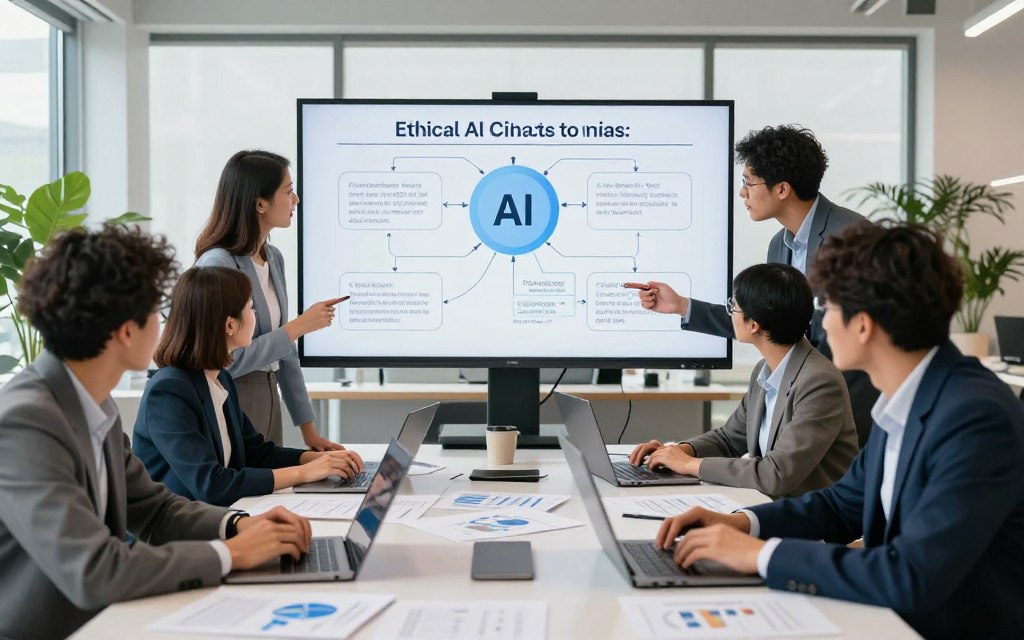
Techniques to Obfuscate AI Fingerprints and Add Value
There are ways to make AI-generated text more diverse and human-like. These methods add real value, making your content more insightful and less formulaic.
Incorporating Personal Insight and Recent Developments
Add personal anecdotes, case studies, or opinions unique to you. Analyse recent events or data to show your critical thinking. This makes your content more human and valuable.
Strategic Paraphrasing and Style Diversification
Vary sentence length and phrasing to avoid AI’s uniform style. Mix short and long sentences. Use synonyms naturally and add rhetorical questions or changes in tone.
“The ethical use of AI in writing is less about the tool and more about the intention. Transparency and added human value are the ultimate defences against accusations of impropriety.”
Proactive Verification with Self-Check Detection Tools
Use tools like GPTZero or Originality.ai for a final check. This is not a guarantee, but a way to assess risks. If a tool flags your content, review it again.
Check if your content relies too much on AI. Can you add more personal analysis? This helps you understand detection boundaries. The goal is to create work so original that detection tools are irrelevant.
Understanding the ethical use of AI and these strategies empowers you. By collaborating, adding value, and being aware of bias in detectors, you make your workflow ethical and efficient.
The Future Landscape: Detection, Regulation, and Norms
The debate on AI and plagiarism is evolving. It’s moving from a simple “caught or not” issue to a complex mix of technology and rules. The solution will combine strong tech measures with ethical standards and a focus on human creativity.
The Technical Arms Race: Watermarking vs. Evasion
Today’s detection tools are reactive and can fail. The future looks towards better, proactive ways to spot AI content. AI content watermarking is a leading idea, where models embed secret clues in their text.
This isn’t a visible mark but a hidden algorithmic signature in word choice or sentence structure. It aims to make AI-generated text easily identifiable by scanners. This shifts the focus from checking after creation to the source itself.
This sparks a race in technology. Detection tools will evolve, and so will ways to remove or mimic these watermarks. The success of cryptographic watermarking will depend on its ability to resist these attempts. The goal is for the watermark to be a fundamental part of the text, not just an addition.
Evolving Institutional Policies and Best Practice Guides
There’s a growing need for policies on AI use. Schools, universities, and industries are creating guidelines to address AI’s role.
The trend is moving from simple bans to more detailed policies. Future guides might include:
- Mandatory disclosure: Clear statements when AI tools have been used in the drafting or ideation process.
- Tiered acceptance: Different rules for brainstorming assistance versus final-draft generation.
- Skill-based assessment: Redesigning evaluations to measure uniquely human skills like critical analysis, personal reflection, or real-world synthesis.
This shift sees AI as a tool while keeping intellectual rigour safe. A university leader noted, this challenge could fundamentally improve our approach to creation and learning.
It may nudge us toward more deeply human approaches to teaching, assessment, and authorship.
The future will be shaped by three main factors: more reliable technology like advanced AI content watermarking, fairer and clearer policies from institutions, and a cultural shift that values transparent, human-centred contribution. Success will come from creating an environment where technology is both visible and thoughtfully integrated.
Conclusion
So, can a chatbot be caught for plagiarism? The answer is often yes. Tools like Turnitin and GPTZero can spot AI-generated text by looking at patterns.
This detection is not perfect. It can lead to false positives, mainly for those who are not native English speakers. It also affects writers who use a lot of formulas. Just finding plagiarism doesn’t mean it’s wrong.
The real question is about using this powerful tool right. It’s about how we mix it into our work and studies. The main issue is about who gets credit for the work, being original, and being open.
We need to change how we think about using chatbots. It’s not just about avoiding getting caught. We should aim to create content that is both ethical and valuable. This means adding our own ideas, editing well, and making sure our work is unique.
Being committed to ethical AI use is key. We should say when AI helps us, use chatbots to edit, and check our work with tools. This way, we can use AI without losing our authenticity.
The battle between creating and detecting AI will keep going. But true success comes from sticking to values like honesty, openness, and human control. By focusing on ethical AI use, we make sure AI helps us communicate better, not worse.
FAQ
Can AI-generated content from chatbots like ChatGPT be detected by plagiarism checkers?
Yes, it can be detected more often now. Tools like Turnitin, GPTZero, and Originality.ai look for signs in the text. These signs include low perplexity and burstiness, common in AI writing. But, it’s not always accurate and can wrongly flag some texts, mainly those written by non-native speakers.
How do AI detection tools actually work?
These tools check two main things: perplexity and burstiness. Perplexity shows how predictable the text is to AI. Burstiness looks at sentence structure and length variation. AI texts often have lower perplexity and more uniform burstiness, making them detectable.
If my work is flagged as AI-generated, does that automatically mean I have plagiarised?
Not always. Being flagged as AI-generated doesn’t mean you’ve plagiarised. It’s about how you use AI tools. If you’ve clearly stated and cited your AI tool use, it might be okay. The issue is when you pass off AI content as your own without saying so.
Are AI detectors reliable, and can they be wrong?
AI detectors are not perfect and can make mistakes. A study from Stanford University found they might wrongly flag over 50% of essays by non-native speakers. They can be tricked by clever prompts and struggle with edited or mixed human-AI content.
What can I do to use AI writing tools ethically and avoid plagiarism accusations?
Use AI tools wisely. Think of them as tools for brainstorming and structuring, not just writing. Always rewrite the content yourself. Add your own thoughts, stories, and references. Know your institution’s AI policy and disclose AI use when needed. Running your work through a detection tool can also help.
What is being done to improve the fairness and accuracy of AI content detection?
The field is growing fast. Researchers are working on new tech, like watermarking, to mark AI content. Schools and industries are also changing their policies. They want to be fairer and value human creativity more.
What are the real-world consequences of submitting detected AI content as my own?
The penalties can be harsh. You might fail a course or even get expelled. Professionally, it can harm your reputation and lead to legal trouble. It also damages trust in publishing and client work.
What immediate steps should I take if I’m concerned about AI detection in my work?
First, check your institution’s or employer’s AI policy. Then, make sure to cite any AI use clearly. Edit and rewrite your work to add your own touch. Using detection tools like Turnitin’s AI writing indicator can also help, but it’s not a full guarantee.


 By
By